Bedford, NY Equestrian Property Buying Guide
May 7, 2026
May 7, 2026
Looking for horse property in Bedford can feel exciting and complicated at the same time. You may be picturing paddocks, trails, and a barn that fits your lifestyle, but the right property is about much more than charm and acreage. If you want to buy with confidence, you need to understand how Bedford’s zoning, site conditions, access, and financing can affect what you can actually do with the land. Let’s dive in.
Bedford has a long-standing horse-country identity, and the town openly recognizes horses as part of its character. Town materials also note that Bedford includes about 3,000 acres of preserves and sanctuaries, along with some town, county, and state parks that offer horse trails.
The trail network is one of Bedford’s biggest draws, but it deserves a closer look. The town says the area includes more than 100 linear miles of private interconnected trails maintained by BRLA, and BRLA trail rules make clear that at least part of that system is membership-based. That means you should confirm whether trail access is deeded, membership-based, or simply nearby before you buy.
In Bedford, not every large parcel allows horse keeping. The town’s zoning districts include R-4A, R-2A, R-1A, R-1/2A, and R-1/4A, but horse keeping is allowed only as an accessory use on conforming lots in the R-2A and R-4A districts.
This is one of the most important filters in your search. A property may look ideal for horses, but if it is not in the right zoning district or does not qualify as a conforming lot, your plans may not match what the code allows.
Bedford’s code sets a clear acreage formula for horse keeping:
That sounds simple, but the usable result can be more limited than buyers expect. If adjoining lots have common beneficial ownership, the town treats them as one lot for this purpose.
Setbacks are just as important as total acreage. Bedford requires:
These standards can shape where a barn, paddock, or manure area can actually go. On paper, a property may seem large enough, but the buildable and usable layout may tell a different story.
A beautiful estate with a barn is not always the same as a practical equestrian property. In Bedford, the legal right to keep horses is only one part of the picture. You also need to know how much land is usable for turnout, how the improvements are sited, and whether the existing setup supports your intended use.
Wetlands and water features can reduce how much lot area counts toward zoning and planning standards. Bedford’s subdivision standards limit how much required lot area can be satisfied by water or mapped wetlands, allowing only 25% in most districts and 50% in R-4A.
That matters if you are counting on open land for paddocks or pasture. A parcel may have generous acreage overall, but wetlands, buffers, septic areas, and driveway needs can reduce the portion that works for horses.
Bedford also restricts targeted vegetation management in regulated wetland buffers unless it is permitted. If you are planning to clear, improve, or rework certain areas for turnout or circulation, those limits should be reviewed early in the process.
For buyers, this is a practical issue, not just a technical one. It can affect how easily you can maintain sightlines, fencing plans, drainage, and grazing areas over time.
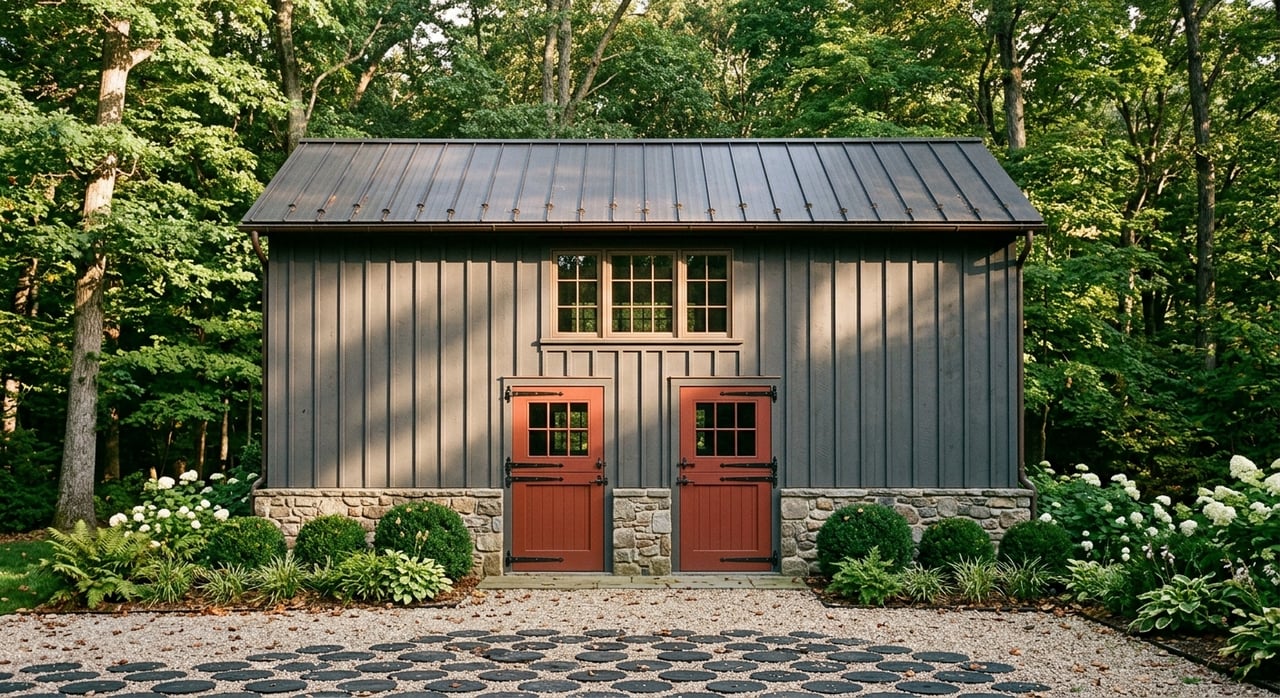
In Bedford, barns are listed as accessory structures in all districts, but size and height still matter. The ground floor of an individual accessory building cannot exceed 0.5% of lot area, and any accessory structure over 2,500 square feet or over 20 feet high requires a special permit.
This is especially important if you want an indoor arena, a larger stable, or room to expand later. What looks like a simple improvement can quickly become a planning issue, not just a construction project.
If your plans go beyond private residential use, Bedford’s code becomes even more specific. Boarding 10 or more horses requires a Planning Board special permit.
Riding instruction is also limited. It is allowed only if there is no paid advertising and only one pupil is taught at a time, while commercial livery stables are not permitted.
A horse property needs to function in all seasons and for more than passenger cars. If the property is being subdivided or substantially improved, Bedford’s subdivision standards call for safe driveway access and set a 14% maximum driveway gradient.
That can be a major issue for horse trailers, service vehicles, manure trucks, and winter driving. A dramatic driveway may look appealing, but function and safety should come first.
If a structure includes space where people live, sleep, eat, work, or congregate, Bedford requires toilet facilities connected to a public sewer, septic tank, or another disposal method approved by the Westchester County Department of Health. This matters if a barn includes a bathroom, apartment, office, or other occupied area.
In those cases, septic capacity and health-department review should be part of your due diligence. It is not enough to confirm that a barn exists. You also want to know whether its current use and layout align with local requirements.
Bedford’s Aquifer Protection Zone rules are intended to protect groundwater quality. These rules include special-permit requirements for certain wastewater systems and restrictions on hazardous-material storage.
For equestrian buyers, that can affect fuel tanks, wash-water drainage, and manure-related site planning. If you are evaluating a property with existing equestrian infrastructure, it is wise to review whether the setup appears consistent with these standards before closing.
Financing a Bedford horse property is not always the same as financing a standard suburban home. FHFA sets conforming loan limits by county each year, so before you move forward on a higher-priced property, you should confirm whether the purchase fits within current conventional limits or may require jumbo financing.
Property type also matters. Fannie Mae says the mortgaged premises must be residential in nature, legal or legal nonconforming, accessible by roads that meet local standards, served by utilities that meet community standards, and suitable for year-round use.
Fannie Mae does not purchase mortgages on vacant land, agricultural properties such as farms or ranches, or properties primarily used for agricultural or commercial purposes. That means some Bedford equestrian properties may fit standard residential lending, while others may call for jumbo or specialty financing depending on the property’s character and use.
If the property is a true horse-business or agricultural asset, specialized financing may be needed. This is one reason it helps to sort out use, zoning, and improvements early, before you get too far into contract discussions.
Horse-property appraisals can also be less straightforward than a typical suburban valuation. Fannie Mae’s rural appraisal guidance notes that rural properties often have large lot sizes and may have fewer recent truly comparable sales nearby, so more distant comparables may be acceptable if the appraiser explains the choice.
For you as a buyer, that can affect timing, underwriting, and expectations around value. A property’s appeal to an equestrian buyer does not always translate neatly into a standard appraisal model.
Some buyers look at Bedford equestrian property as a residential lifestyle purchase, while others are considering a working horse operation. In New York, that distinction can matter for taxes.
State tax guidance says land used as a single operation with 7 or more acres and $10,000 or more in annual gross sales may qualify for agricultural assessment, including land supporting a commercial horse boarding operation. In other words, a working horse property may be taxed differently from a purely residential estate parcel, but only if the required use and acreage standards are met.
If the property uses a private well, Westchester County says well-water systems must be tested upon sale of property and for leased properties in the county. That means water testing should be built into your contract contingencies and timeline.
This is a small step that can have a big impact on peace of mind. It is especially important on larger rural and estate properties where private systems are more common.
Before you move forward on any Bedford horse property, make sure you get clear answers to the right questions:
These questions matter because Bedford’s land-use process involves multiple local bodies, including the Town Board, Planning Board, Wetlands Control Commission, Historic Building Preservation Commission, and ZBA. A careful review upfront can help you avoid surprises later.
Buying equestrian property in Bedford is rarely just about finding acreage and a barn. You are also evaluating zoning, permits, siting, access, water, and how the property will function for your specific goals.
That is where experienced local guidance becomes valuable. With a niche property type like this, small details can have an outsized effect on usability, financing, and long-term satisfaction. If you are considering an equestrian purchase in Bedford or elsewhere in Westchester, Marcie Nolletti can help you navigate the details with a high-touch, informed approach.
Marcie remains focused on the needs of her clients to deliver professional, knowledgeable, and dedicated service. Her goal is to be your Real Estate Professional for life. "Who you work with matters."

338 ROUTE 202
SOMERS NY 10589